
What Your Fertility Doctor Wants You to Know About PMOS, IVF, and Surrogacy | ACRC Global Webinar Series

The path to parenthood is rarely a straight line. For many Intended Parents, it winds through diagnoses, decisions, and deeply personal questions that deserve honest, expert answers. That is exactly why ACRC Global hosted a three-part webinar series with Dr. Carolyn Alexander, a board-certified Reproductive Endocrinologist at the Southern California Reproductive Center (SCRC), trained at Johns Hopkins and Cedars-Sinai.
Over three candid conversations, Dr. Alexander and ACRC Global's Elizabeth Jameson covered everything from the newly reclassified PMOS diagnosis, to navigating failed IVF cycles, to the medical realities of surrogacy and egg donation. This blog post brings together all three parts of that conversation — with direct quotes from Dr. Alexander — so you can watch, learn, and take your next step with confidence.
Part 1: Understanding PMOS and Building Your Fertility Treatment Plan
Why PCOS Is Now Called PMOS
If you have been diagnosed with Polycystic Ovary Syndrome (PCOS), you may soon hear your doctor refer to it as PMOS Polyendocrine Metabolic Syndrome. This is not just a name change. It reflects a fundamental shift in how reproductive medicine understands the condition: not as a single ovarian disorder, but as a complex, multi-system pathophysiology.
In Dr. Alexander's own words:
"It's a multi-system pathophysiology with no clear causal factors. It's partly genetics, partly endocrine disruptors and environmental factors that kind of cascade into different elements that people feel. And so that's why you may even have cousins or siblings or people that have different symptomatology — it's a poly-endocrine issue."— Dr. Carolyn Alexander, 06:14
This means that two people with PMOS can present entirely differently. One may experience elevated androgens causing cystic acne or hirsutism (unexpected hair growth in male-pattern areas), while another may primarily deal with metabolic complications such as altered cholesterol panels, elevated diastolic blood pressure (a precursor to chronic hypertension), sleep apnea, or NASH (Non-Alcoholic Steatohepatitis fat deposits in the liver that can affect even slim individuals). Understanding this complexity is the first step toward getting the right treatment plan.
The Biggest Misconception: That Pregnancy Is Impossible
Many patients arrive at their first fertility consultation carrying enormous fear. Pediatricians and OBGYNs sometimes communicate a PMOS diagnosis in ways that leave patients feeling like conception is an insurmountable challenge. Dr. Alexander addresses this directly and compassionately:
"I think it's a little hard when sometimes our patients come in and they're so petrified that it'll be such a high hill to climb to conceive, where sometimes just a little finesse to get people to ovulate and we can help them get pregnant relatively easily. It does, even for myself again, being kind of an older parent, it was this little fear that feels like a weight on us as people." Dr. Carolyn Alexander, 11:43
The message is clear: PMOS requires attention and optimization, but for many patients, it is far from an impossible journey.
How Dr. Alexander Builds a Personalized Fertility Plan
When a patient comes in for a fertility evaluation, Dr. Alexander begins with a structured but deeply individualized assessment. The first priority is checking ovulation and ovarian reserve:
"We want to make sure to check on ovulation and the ovarian reserve tests, such as the anti-mullerian hormone level. We found that if that is extremely high, like above 11, there can be a smoke signal that's a signal of inflammation." Dr. Carolyn Alexander, 13:14
Beyond AMH, she evaluates fallopian tube patency, conducts a recent semen analysis (noting that factors like COVID-19 or vaping can rapidly alter sperm quality), and assesses BMI and nutrition. When it comes to deciding between natural conception and IVF, she takes a holistic view:
"I try to get a sense from both partners where they are what their family building goals are, how many kids they want. I use the AMH as a tool, but it's not a perfect test, as well as the Day 3 FSH and estradiol. You want your FSH less than 10 and estradiol 30 to 60 to kind of get a vibe on egg quality as well as how your ovarian function is too." Dr. Carolyn Alexander, 16:59
From there, she develops a statistical Plan A, Plan B, and Plan C a roadmap that empowers patients rather than leaving them guessing.
Personalized Care Means Knowing Your Full Story
No two fertility journeys are alike, and Dr. Alexander's approach reflects that. Personal and family medical history shapes every treatment decision:
"If our mom or sister had breast cancer, sometimes we have to be a little frugal with the medications because we don't want to cause the estrogen to go too high. If we have a strong family history of blood clotting disorders, we'll double check for Factor V Leiden or these genes that can make us more prone to blood clotting issues."— Dr. Carolyn Alexander, 18:42
She also considers past surgeries (appendicitis can affect fallopian tube patency), the presence of endometriosis (noting a new blood test called "Hernova"), and the patient's puberty timeline — all to build a treatment plan that is safe, effective, and uniquely theirs.
Key Fertility Test | What It Measures | Why It Matters |
AMH (Anti-Mullerian Hormone) | Ovarian reserve | Very high levels (>11) may signal inflammation and gestational diabetes risk |
Day 3 FSH | Pituitary hormone signaling ovaries | FSH <10 indicates healthy ovarian function |
Day 3 Estradiol | Estrogen baseline | Target 30–60 for optimal egg quality assessment |
Semen Analysis | Sperm count, motility, morphology | COVID-19 and vaping can rapidly degrade sperm quality |
Fallopian Tube Patency | Open pathways for egg travel | Prior surgeries or endometriosis can cause blockages |
Part 2: When IVF Is Not Enough — Navigating Donor Eggs and Surrogacy
After Failed IVF Cycles: What Comes Next?
Experiencing one or more failed IVF cycles is one of the most emotionally difficult moments in a fertility journey. It does not mean the journey is over — it means the path forward requires a new conversation. Dr. Alexander explains how she approaches this with her patients:
"Sometimes if our FSH is over 40 on two occasions, that's like a textbook way to think about whether we should keep trying on your own ovaries when your pituitary is already trying so hard with the level of FSH to make your body ovulate."— Dr. Carolyn Alexander, 03:48
In addition to hormonal markers, structural and genetic factors also come into play. Asherman's syndrome (scarring inside the uterus), repeated embryo implantation failure, and even rare cases where the male partner carries an autosomal dominant gene can all shift the conversation toward alternative paths:
"Occasionally it'll happen where even on the male side they carry an autosomal dominant gene that's very challenging and we have to actually have a conversation about donor sperm in light of circumstances and statistics."— Dr. Carolyn Alexander, 01:09
When Donor Eggs Become the Right Choice
The decision to use donor eggs is deeply personal, and Dr. Alexander approaches it with sensitivity and scientific clarity. For patients in their mid-40s who are determined to try with their own eggs, she offers both honesty and compassion:
"I try to mantra to myself that my goal is a healthy full term baby. I tend to see a lot of patients who are in their mid-40s who realize now I really really want a chance, please give me a chance to try with my own eggs... but then the hard part is the chromosomes get sticky when we get into our 40s and that's why there's the risk of the extra piece of a chromosome which can be unhealthy for a pregnancy."— Dr. Carolyn Alexander, 09:55
At ACRC Global, our proprietary egg donor database allows Intended Parents to search for carefully screened donors based on a wide range of criteria — physical characteristics, education, health history, and more — giving families a meaningful connection to the process.
When Surrogacy Enters the Conversation
Gestational surrogacy becomes a medically necessary conversation in several distinct scenarios. Dr. Alexander outlines the most common:
"Here we've had a few patients and it'll happen in a row where they've had a C-section and then had bleeding and had a hysterectomy and their next pregnancy has to be with a surrogate. Also if we've had lupus nephritis or these tougher health conditions... once you make it through the stages of acceptance, then it's good to think about the option of surrogacy."— Dr. Carolyn Alexander, 01:41
"If there's any health issue where you can't carry, or the maternal-fetal medicine team recommends that it's for cardiac issues or other health issues it's better to not carry the pregnancy, you can get good embryos and then prepare for a surrogate."— Dr. Carolyn Alexander, 04:20
Medication dependency is another critical factor. Some patients rely on drugs that are incompatible with pregnancy:
"Medications is a lot too. We had a patient on methotrexate where she feels fantastic on it for her rheumatoid arthritis but she can't be on that to try to get pregnant."— Dr. Carolyn Alexander, 08:02
What Intended Parents Should Know Before Pursuing Surrogacy
Before beginning a surrogacy journey, Dr. Alexander emphasizes both medical and psychological preparation. Medically, a surrogate's uterus must be evaluated — typically via a saline sonogram — and she must begin prenatal vitamins at least three months before transfer to prevent conditions like spina bifida. The surrogate's lifestyle, health history, and prior pregnancies are all carefully reviewed.
"We really want the surrogates to be as healthy as possible — exercising, eating right, making sure they're not on any medications that are not ideal. Look at their history and their family history and the history of their pregnancies."— Dr. Carolyn Alexander, 05:48
"For the surrogate, the saline sonogram — or whichever avenue to verify that the inside wall is smooth — and that she's on her prenatal vitamin for three months ahead to prevent spina bifida."— Dr. Carolyn Alexander, 06:37
On the psychological side, Dr. Alexander highlights the importance of how Intended Parents plan to speak with their future child about their origins:
"I think it's important to discuss openly how you want to discuss it with your future child in terms of the psychological discussions."— Dr. Carolyn Alexander, 05:06
This aligns directly with ACRC Global's program requirements. As Elizabeth Jameson explained during the webinar, all Intended Parents in the ACRC program are required to consult with a psychologist before proceeding — ensuring families are emotionally prepared for every stage of the journey.
Part 3: Epigenetics, Misconceptions, and the Truth About Donor Eggs and Surrogacy
The Science of Epigenetics: Why the Surrogate's Environment Matters
One of the most powerful and frequently misunderstood aspects of surrogacy and egg donation is the role of epigenetics. Many Intended Parents worry that a lack of direct genetic connection diminishes their bond with their child. Dr. Alexander offers a perspective that is both scientifically grounded and deeply reassuring:
"I think what's fascinating is epigenetics. So all of us get a chromosome from both our parents and certain changes on the chromosomes such as methylations or histone issues or DNA — different little changes — that's why our siblings are different. It's interesting to think during pregnancy what nutritional things, what toxins, what stress, sleep disturbances, all these different things can influence epigenetics."— Dr. Carolyn Alexander, 08:41
In other words, the environment a surrogate provides during pregnancy — her nutrition, her stress levels, her sleep — actively shapes the child's development at a molecular level. The surrogate is not simply a vessel; she is a nurturing environment that contributes meaningfully to who that child becomes.
Nurture Is Not Secondary to Nature
Beyond the biology of pregnancy, Dr. Alexander emphasizes the profound impact of the environment in which a child is raised:
"How we nurture in our environment when you're raising the child makes a big big difference with all the cognitive things and the goals that you have for your family."— Dr. Carolyn Alexander, 09:40
This is a message of empowerment for every Intended Parent who has ever wondered whether a genetic connection is the only connection that matters. It is not. The love, the environment, and the intentionality with which you raise your child are equally — if not more — formative.
Addressing Your Fears Directly
Dr. Alexander has a unique approach to patient fears: she asks them to name them out loud.
"I tell people: write out your fears and tell me what are the fears. Because I'm always a little interested to know that it isn't what I'm thinking as the doctor to be afraid of — their fears are different than what I was thinking."— Dr. Carolyn Alexander, 10:48
This practice of naming fears is clinically powerful. Intended Parents often worry about things that are statistically rare (like ectopic pregnancies), while overlooking factors that are more medically significant. By surfacing these fears, Dr. Alexander can address them with data, context, and compassion — replacing anxiety with informed confidence.
What About What the Surrogate Eats?
One of the most common concerns Intended Parents raise is about the surrogate's daily habits — particularly her diet. Dr. Alexander addresses this with characteristic warmth:
"I think a lot of people worry what the surrogate's gonna eat. But I always say they already had two full term healthy kids, they're getting good grades... sometimes they'll bring the kids and I meet them and so I always think to myself they're probably being as healthy as they can be."— Dr. Carolyn Alexander, 11:36
ACRC Global's surrogate screening process reinforces this. Every surrogate in our program is thoroughly vetted for her medical history, prior pregnancies, lifestyle, and overall health — so Intended Parents can move forward with confidence and peace of mind.
Ready to Start Your Family-Building Journey?
Whether you are navigating a PMOS diagnosis, processing the results of multiple IVF cycles, or exploring surrogacy and egg donation for the first time, you do not have to figure this out alone.
At ACRC Global, we partner with leading reproductive specialists like Dr. Carolyn Alexander to ensure every Intended Parent receives expert medical guidance alongside compassionate, personalized agency support. With a 95.6% live birth success rate, offices in 15+ countries, and a "No Match, No Fees" policy, we are committed to making your journey as seamless and supported as possible.
Watch the Full Webinar Series
Part | Topic | Watch Now |
Part 1 | PMOS, Fertility Evaluation & Personalized Treatment Plans | |
Part 2 | Failed IVF, Donor Eggs & When to Consider Surrogacy | |
Part 3 | Epigenetics, Misconceptions & Surrogate Screening |
This blog post is based on an educational webinar hosted by ACRC Global featuring Dr. Carolyn Alexander, Reproductive Endocrinologist at the Southern California Reproductive Center (SCRC). All content is for informational purposes only and does not constitute medical or legal advice. Please consult a qualified medical professional for guidance specific to your situation.
ACRC Surrogacy & Egg Donation is a New York State Department of Health Licensed Surrogacy Agency (License #GSP220901) and an ASRM Member (ID: 00108609), supporting families in 45+ countries worldwide.
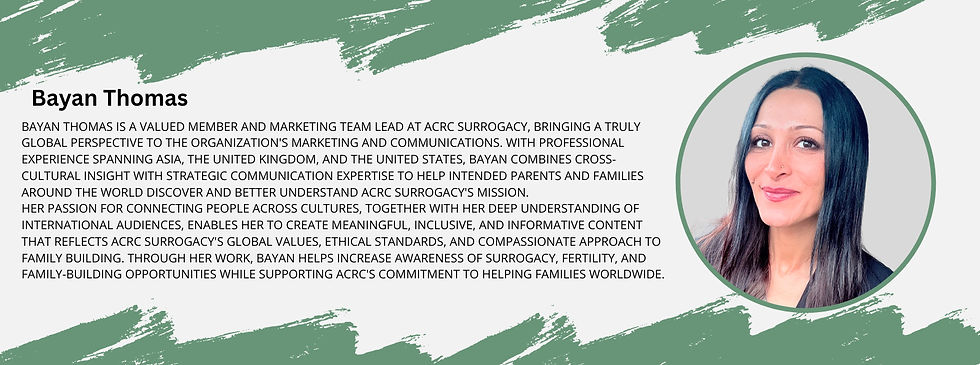
About the author:


Comments